
Hardware and custom software
Queue management system: ticket, screen and voice for clinics, offices and shops
A queue management system is a set-up where a person takes a number and, when it is their turn, a screen or a voice calls them. Below you find the kinds of systems, what they consist of, what the software does, how patient privacy is protected and how the work goes.
Updated: November 2026
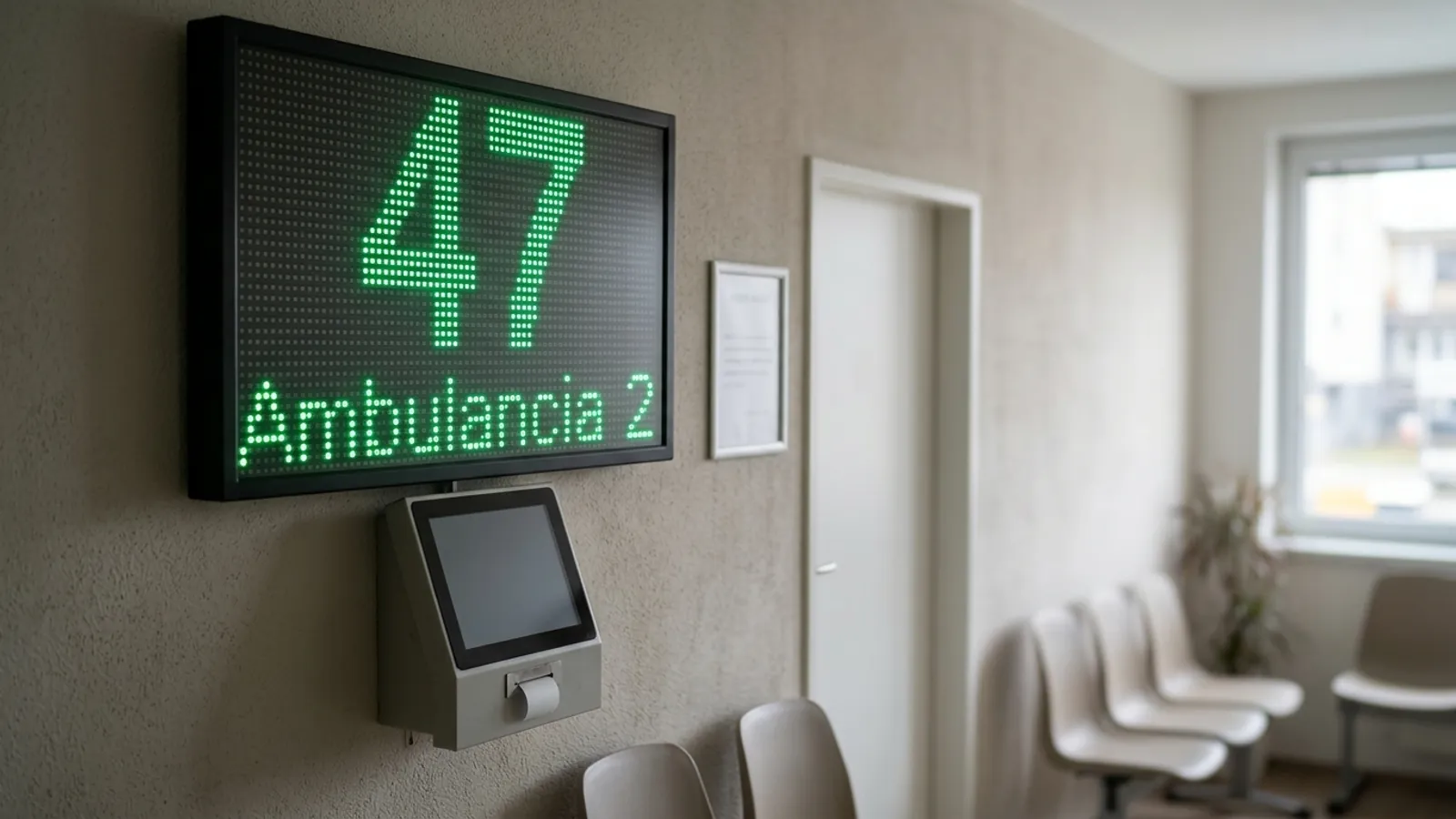
Queue management system: the direct answer
A queue management system, called a poradový systém in Slovak, is a set-up where a person takes a number, sits down and, when it is their turn, a screen or a voice calls them. Nobody stands in line and nobody has to shout a name into the waiting room.
It is used in clinics, pharmacies and offices, and also in restaurants and pick-up points. Grew Studio supplies the device, custom software and installation.
We choose the concrete set-up in the offer, once we know the premises and what the system should do. We do not publish a price. Below you find the kinds of systems, their parts, what the software does, privacy when calling patients, accessibility and how the work goes.
What a queue management system consists of
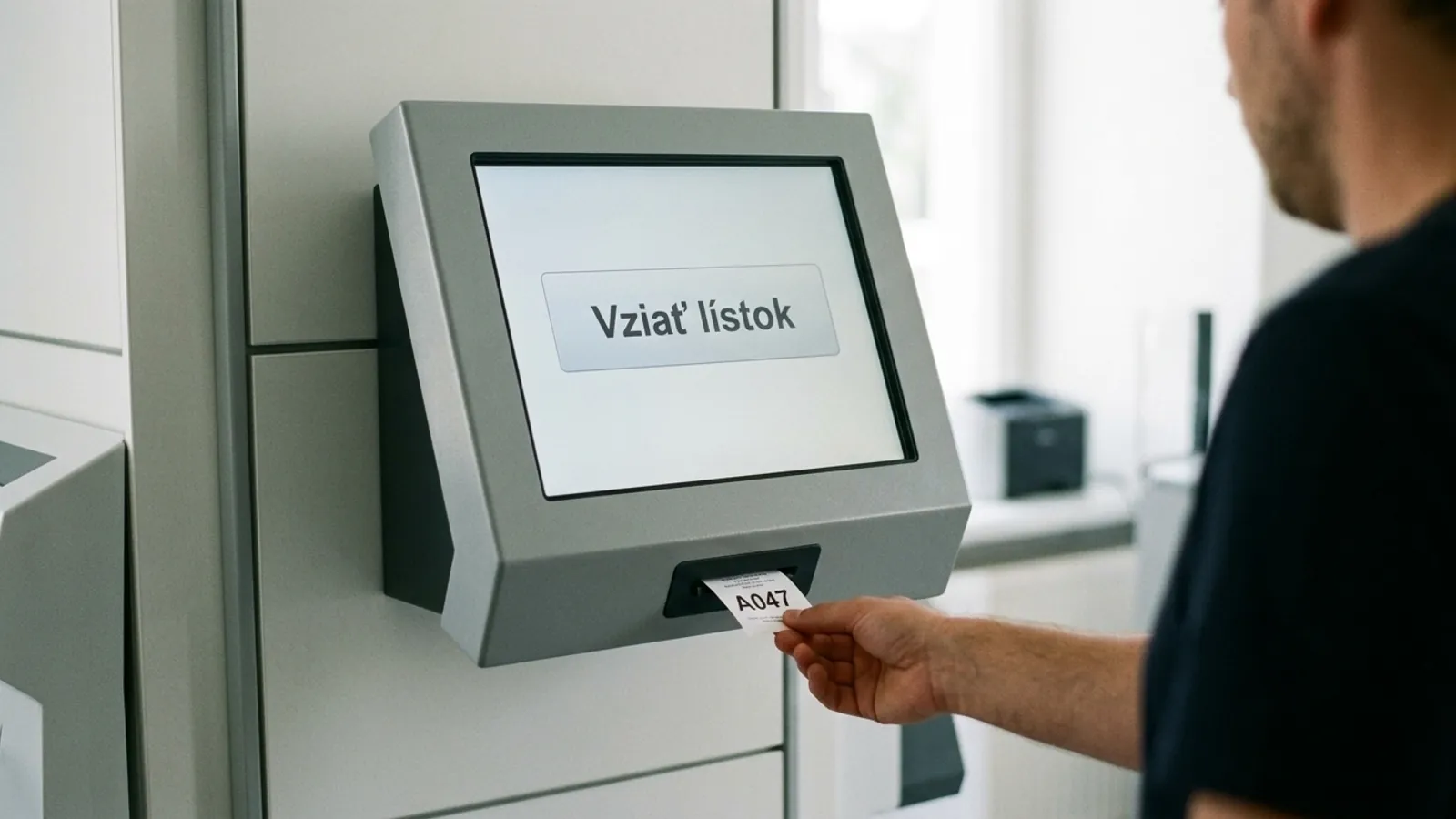
A queue management system has several parts. According to a Czech overview, the core is a central unit, that is software or a dedicated device, that holds the order and decides who is next. The other parts connect to it.
- A way to get a number: a ticket printer or touchscreen, a link in the phone via QR code, or a receptionist who adds the person.
- A screen in the waiting room that shows the number and can be accompanied by a sound signal or a voice.
- A control panel at each counter or in each consulting room. The staff member presses the button for the next person.
- Optional parts: a module for sending text messages, a connection to bookings, and statistics.
Kinds of queue management systems
There are several kinds, and you choose by who comes to you. For clinics, pharmacies and offices a ticket terminal with a screen and voice is typical.
For restaurants and pick-up points an order number on a screen or a pager fits better. A pager is a small device that vibrates when the order is ready.
The third kind is a virtual queue. A person joins by phone or QR code and learns about their turn on a screen or by message. A ticket terminal with a touchscreen is close to the self-service device described on the page about the self-service kiosk.
| Kind (where it is used) | How a person gets a number | How they are called | What to watch |
|---|---|---|---|
| Ticket terminal with screen and voiceclinics, pharmacies, offices | From a ticket printer or touchscreen, or a receptionist adds them | Number on a waiting-room screen with a sound signal or voice | Accessibility of the terminal and what data is entered with the ticket |
| Order number on a screenrestaurants, bakeries, pick-up points | They get the number when ordering | The number appears on the screen when the order is ready | The screen must be clearly visible from where people wait |
| Pagerrestaurants, pick-up points | They get a pager when ordering | The pager vibrates when the order is ready | Radio band, declaration of conformity, charging and returning pagers |
| Virtual queue by SMS or QR codeclinics, offices, pick-up points | Through a link in the phone or a QR code, or staff add them | By message or on a screen | Consent to messages, privacy and people without a phone |
Scroll the table sideways.
What the queue software does and what it can connect to
The software decides who is next, which makes it more important than the screen. These functions are common in systems on the market, and we design them as part of custom software.
Connection to bookings: a Slovak service for clinics describes that walk-ins on the day are gradually fitted between booked slots. Such a mixed mode is set up in the software.
Some suppliers state a connection to outpatient programs, that is software in which a clinic keeps its records, or an open interface (API), through which two programs exchange data.
A connection to your program or to a custom booking system is designed in the offer, once we know it. We do not promise it in advance.
Websites for clinics are described on the page website for medical practices.
- Several counters or consulting rooms: each calls from one shared order, or has its own.
- Service types: the visitor chooses the reason for the visit and the system puts them in the right order, for example with separate numbering.
- Calling again: when a person does not come at once, staff call them again.
- Changing the order: a staff member can edit the order online and the change can be announced by a sound.
- Statistics: for example visits by hour, so you see when the peaks are and when more people are needed.
- Roles and permissions: who may change the order and who may only see it.
Privacy when calling patients, text messages and people without a phone
With calling by number, no patient's name is heard in the waiting room. A Slovak online service for clinics states that its systems anonymise the calling of patients, and the phone number is optional when the wait is longer than 30 minutes.
The information below summarises sources and is not legal advice. For the set-up, ask your lawyer or data protection officer.
One Slovak clinic states on its page that a patient gets an SMS when two others are ahead. The Slovak electronic communications act 452/2021 Z. z. (section 116(3)) requires prior provable consent for SMS used for direct marketing, that is offering goods or services.
A turn notice offers nothing, but we found no official view on it. Advertising therefore should not be mixed into such messages.
A person without a smartphone gets a number from the terminal, or staff add them to the queue. One Czech supplier offers identification by a touch keyboard for a person with neither an ID nor an insurance card.
- Under the EU data protection regulation (GDPR, Art. 4(1)) an identification number is personal data when it relates to an identifiable person. Under Art. 4(15) data concerning health is personal data related to health, including the provision of health care services, which reveals information about health status.
- Under Art. 5(1)(c) data should be limited to what is necessary. Art. 25 requires data protection already in the design of the system.
- The Czech Office for Personal Data Protection recorded, in an inspection of a public office (18 Aug 2020), that a number from the terminal involves no personal data entry, while the booking collects name, e-mail and phone. It assessed the booking as personal data processing with a controller and a processor.
- We found no law requiring patients to be called by number. We also found no opinion of the Slovak Office for Personal Data Protection on calling by name or number. The Bavarian supervisory authority for the private sector states that addressing by family name is still allowed, and a Czech lawyer in a 2026 article recommends numbers instead.
Accessibility: voice and visual
EU Directive 2019/882 on accessibility requirements lists ticketing machines among self-service terminals, including bank office queuing ticket machines (recital 26). It applies to products placed on the market after 28 June 2025.
For self-service terminals it requires text-to-speech, the use of personal headsets, adequate contrast and tactile controls (Annex I). Whether the duty concerns you or the supplier, confirm with a lawyer.
- Picture and sound: the number is announced on a screen and by a sound signal or voice, so that a person who cannot hear and a person who cannot see both notice it.
- Controls: tactile keys, adequate contrast and speech output are, under the directive, requirements for self-service terminals.
- Entrance: an outpatient facility must have a barrier-free entrance (Decree of the Slovak Ministry of Health 236/2025 Z. z.). When placing the terminal and the control panel, it is worth thinking about reach from a wheelchair.
- For people with a hearing impairment, a separate general authorisation VPR-05/2022 exists for radio assistive listening devices.
Restaurants and pick-up points: number on a screen or a pager
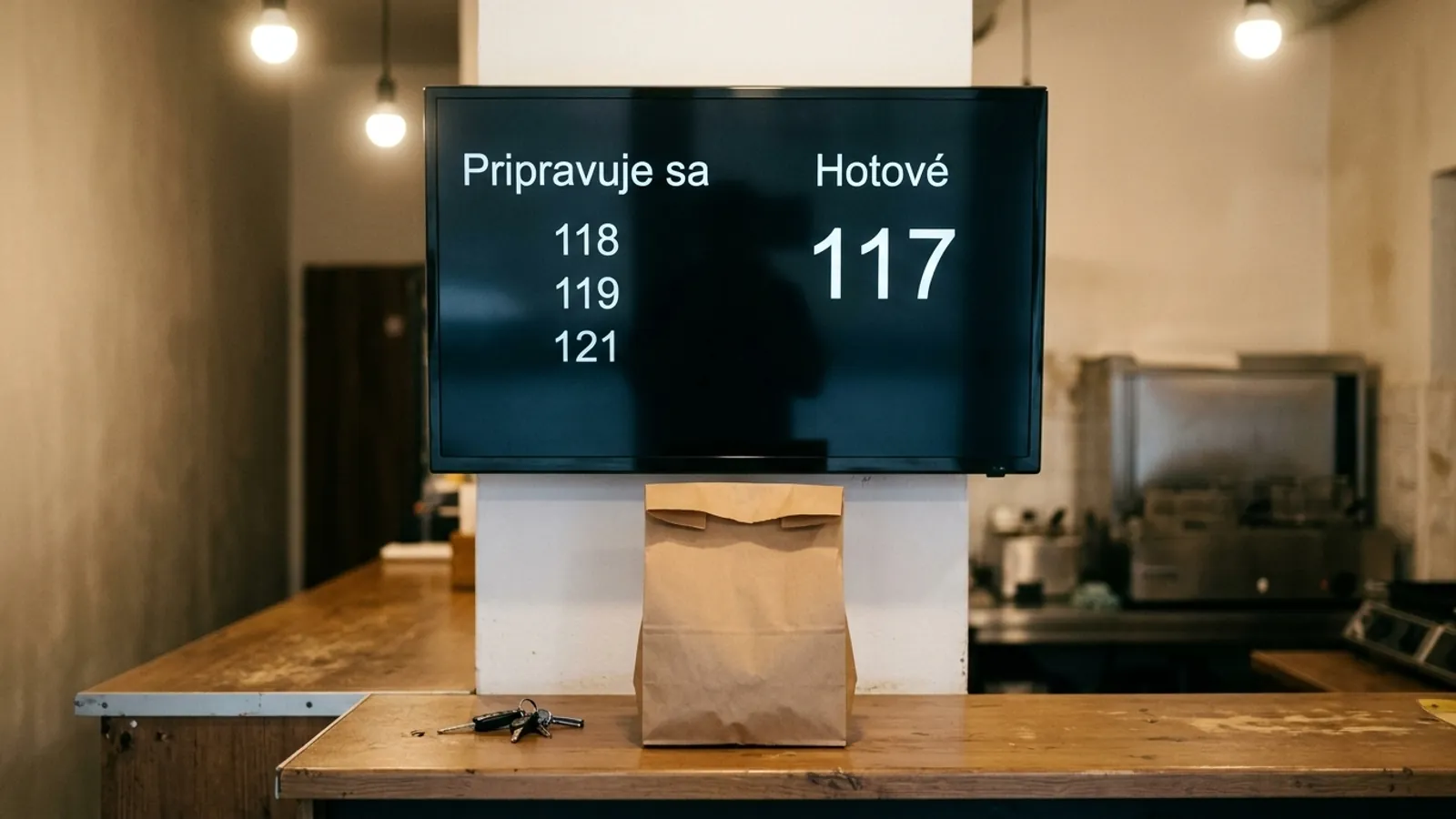
In a restaurant or at a pick-up point an order number on a screen or a pager is used. Screens in a business are described on the page about in-store screens (digital signage). The system can track order states, for example waiting, in preparation, ready and handed over.
A pager is a radio device. A US manufacturer describes a set of a transmitter, a fleet of pagers and a charging base, where each pager has its own code.
The same manufacturer states a frequency typically between 420 and 470 MHz for its US products. The Slovak general authorisation VPR-02/2022, a rule of the regulator for short-range radio devices, lists the bands 433.050 to 434.790 MHz and 863 to 870 MHz. We found no row for 450 to 470 MHz in its table.
- Radio equipment sold in the EU must have a declaration of conformity and the CE marking (Directive 2014/53/EU, Art. 10(3)).
- With pagers, the band and the declaration of conformity therefore need to be checked.
- Range and battery life of pagers depend on the model, the surroundings and the settings. The figures for the delivered model are in the offer.
- A guest can get a number through a link or QR code in the phone instead of a pager.
How the work goes and what to prepare on site
The work goes in the three steps listed below. Figures about power, network cables and installation time are agreed in the offer, because they depend on the set-up and the premises.
To prepare the premises, it helps to know:
- Where the ticket terminal will stand and who can reach it, including from a wheelchair.
- Where the screen will be so that it is visible from the waiting room, and where the control panel at the counter or consulting room will be.
- Where power and network can be brought to each place.
- A waiting room should, under Decree 236/2025 Z. z., adjoin the consulting rooms directly or, if it has a reception, be at the shortest functionally suitable distance, which also helps with placing the screen.
- Which programs you already use: bookings, an outpatient program or a cash register the system should connect to.
- 1Free intro call. We talk about who comes to you, how many counters or consulting rooms you have and what bothers you while people wait.
- 2Documents about the premises. We find out where the devices will go and what they should connect to.
- 3A written offer with an exact scope. Device, custom software, installation and connections, with a price once we know the premises and what the system should do.
Where the data on this page comes from
We read the statements about the set-up, laws and radio bands in the sources on 18 November 2026. We read Slovak laws in the version we found on Slov-Lex that day.
Statements about Slovak online services for clinics come from their public pages, which we do not name here. Sources:
- Wikipedia (Czech), Vyvolávací systém
- Z-ware, call system
- Neklepat.cz, call systems
- Municipality of Bratislava-Rusovce, general practitioner clinic
- Screen Manager, queue calling system
- LRS, restaurant pager guide
- David Maister, The Psychology of Waiting Lines
- EUR-Lex, Regulation (EU) 2016/679 (GDPR)
- Bayerisches Landesamt für Datenschutzaufsicht, calling patients by name
- Právny priestor, patient privacy in a consulting room
- Czech Office for Personal Data Protection, inspection record UOOU-01819/20-11
- Slov-Lex, Act 452/2021 Z. z. on electronic communications
- EUR-Lex, Directive (EU) 2019/882 on accessibility requirements
- Slov-Lex, Decree of the Ministry of Health 236/2025 Z. z.
- Slov-Lex, Act 576/2004 Z. z. on health care
- Slovak telecom regulator, bulletin 8/2022 (general authorisations VPR-02/2022 and VPR-05/2022)
- Directive 2014/53/EU, Article 10
Frequently asked questions
01What is a queue management system and what does it consist of?
It is a set-up where a person takes a number and, when it is their turn, a screen or a voice calls them. It consists of a way to get a number, a central unit with software, a screen in the waiting room and a control panel at each counter. Optionally it includes an SMS module, a connection to bookings and statistics.
02Is a queue management system mandatory in a clinic?
In the health care act 576/2004 Z. z. and in Ministry of Health decree 236/2025 Z. z. we found no provision on the order of waiting patients or on a call system. According to our sources it is a voluntary organisational tool. This is information, not legal advice.
03Must a clinic call patients by number instead of by name?
We found no law requiring it, and no opinion of the Slovak Office for Personal Data Protection on this. The Bavarian supervisory authority for the private sector states that addressing by family name is still allowed, and a Czech lawyer recommends numbers. The system can call by number, so the waiting room learns less. Confirm what suits you with your data protection officer.
04Can the system connect to a booking or clinic system?
Some suppliers state a connection to outpatient programs or an open interface (API), a way for two programs to exchange data. A connection to your program is designed in the offer once we know it, and we do not promise it in advance. The mixed mode of booked and walk-in visits is set up in the software.
05Can the system send text messages, and what does that mean for consent?
It can, if we agree on it in the offer. Under section 116(3) of Act 452/2021 Z. z., an SMS for direct marketing needs provable consent. A turn notice offers nothing, but we found no official view on it, so advertising should not be mixed into such messages.
06What about people without a phone or without touchscreen experience?
They get a number from the terminal, or staff add them to the queue. They do not need a phone for it. One Czech supplier offers identification by a touch keyboard for a person with neither an ID nor an insurance card. The number is announced by picture and by sound.
07Is a queue management system suitable for a restaurant too?
Yes, in a restaurant or at a pick-up point an order number on a screen or a pager is used. With pagers the radio band and the declaration of conformity need to be checked. A US manufacturer states typically 420 to 470 MHz for its pagers, and we found no such row in the table of the Slovak general authorisation VPR-02/2022.
08How much does a queue management system cost?
We do not publish a price and do not yet have one concrete model. We price the device, custom software and installation in a written offer, once we know the premises and what the system should do. The intro call is free.
You might also like
Planning a queue management system?
Book a free call with us. We talk about who comes to you and what the system should do, and then you receive a written offer with an exact scope.